
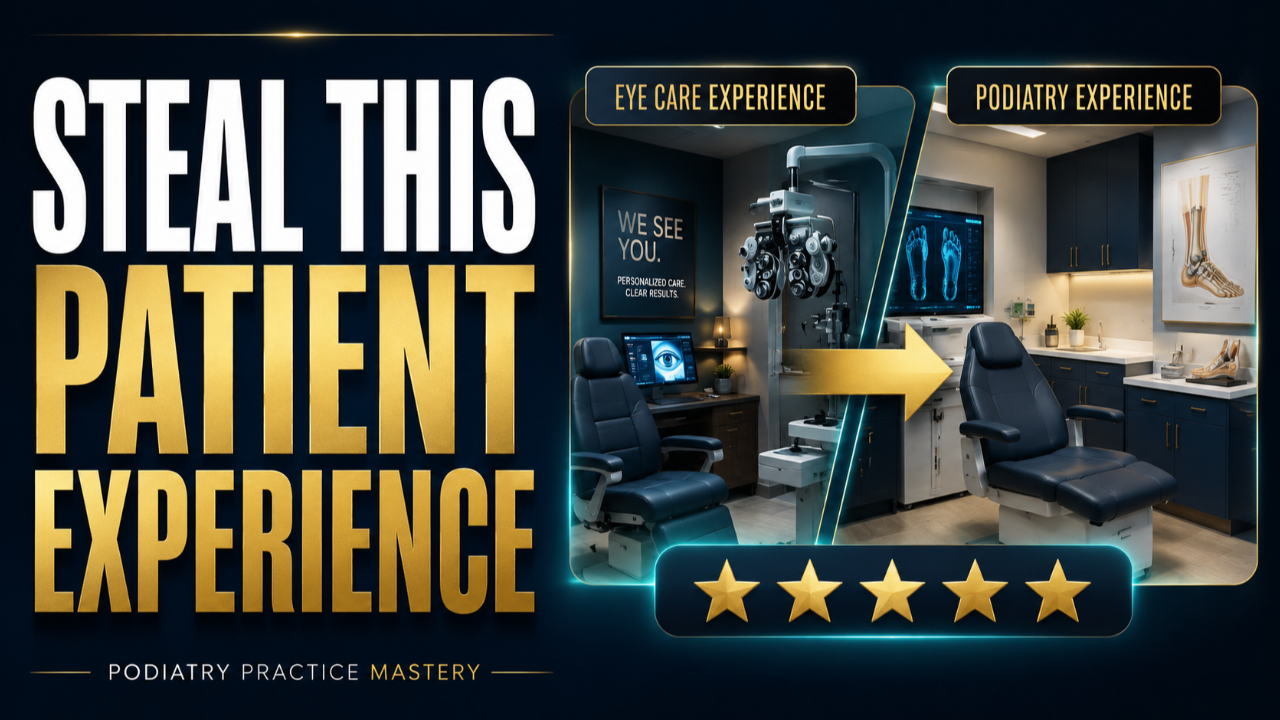
What an Eye Doctor Visit Taught Me About Improving Your Podiatry Practice Experience
READ TIME – 2 MINUTES
Hey everyone, Don here.
Welcome to Podiatry Practice Mastery, where we help you grow your practice to the $2 million mark—and beyond.
Quick reminder before we dive in: I’ve updated my $1,000,000 Practice Formula. Even if you’ve downloaded it before, I’d love for you to grab it again and send me feedback. It really helps me make it better for you.
I want to share a recent experience that gave me some powerful insights into our own practices.
As some of you know, my dad is dealing with dementia. He lives locally, so I often go with him to his doctor appointments. Anytime I’m in a healthcare setting as a patient or family member, I try to look at it through two lenses:
- What worked well?
- What could have been better—and how can I apply that to my own practice?
Recently, we visited an ophthalmologist, and there were some great lessons worth sharing.
What They Did Well
First off, scheduling was easy. Nothing fancy—but smooth.
What really impressed me was how much the medical assistant handled upfront. They essentially did a full optometry-style workup—refractions, imaging, all the preliminary testing. That freed the ophthalmologist to focus on the things only he could do.
It got me thinking:
- Could my staff be doing more ultrasounds?
- Shockwave?
- Additional diagnostics?
- Even more patient education?
My staff already does X-rays and nails. There’s probably more we can safely and appropriately delegate so we stay focused on high-value doctor tasks.
Another thing I liked: automatic one-year follow-ups.
I realized I don’t routinely bring patients back yearly unless there’s a specific issue. But imagine having a simple 10-minute annual check-in—orthotics, biomechanics, skin, nails, overall foot health. That’s better care and better continuity.
What Didn’t Work So Well
A few misses stood out.
The doctor used a lot of big medical words. I understood them—but my dad had no idea what was going on. It reminded me how easy it is to forget what patients don’t know.
There was also very little explanation during the exam. Things were just… done. That brings me back to something I’ve talked about before: the running commentary.
Patients don’t need permission for every step—but they do need context.
“Here’s what I’m checking.”
“Here’s why this matters.”
“Here’s what I’m looking for.”
Think about how often we look at X-rays and say nothing. Or examine a foot and react without explaining. Patients are left wondering, “Is something really wrong?”
Lastly, the visit felt rushed—and the doctor was documenting the whole time. No scribe.
That’s where scribes (or AI scribes) really shine. When you speak out loud—whether to a scribe or AI—you’re naturally giving that running commentary, and the patient benefits from it too.
You can even say: “I’m going to talk through this while I document—it’ll help you understand what I’m seeing.”
Key Takeaways
- Delegate more to your staff so you can focus on doctor-only tasks
- Consider annual follow-ups for all patients, not just as-needed visits
- Use simple language—especially with older or confused patients
- Practice a “running commentary” so patients always know what’s happening
- Scribes (human or AI) can improve documentation and patient experience