
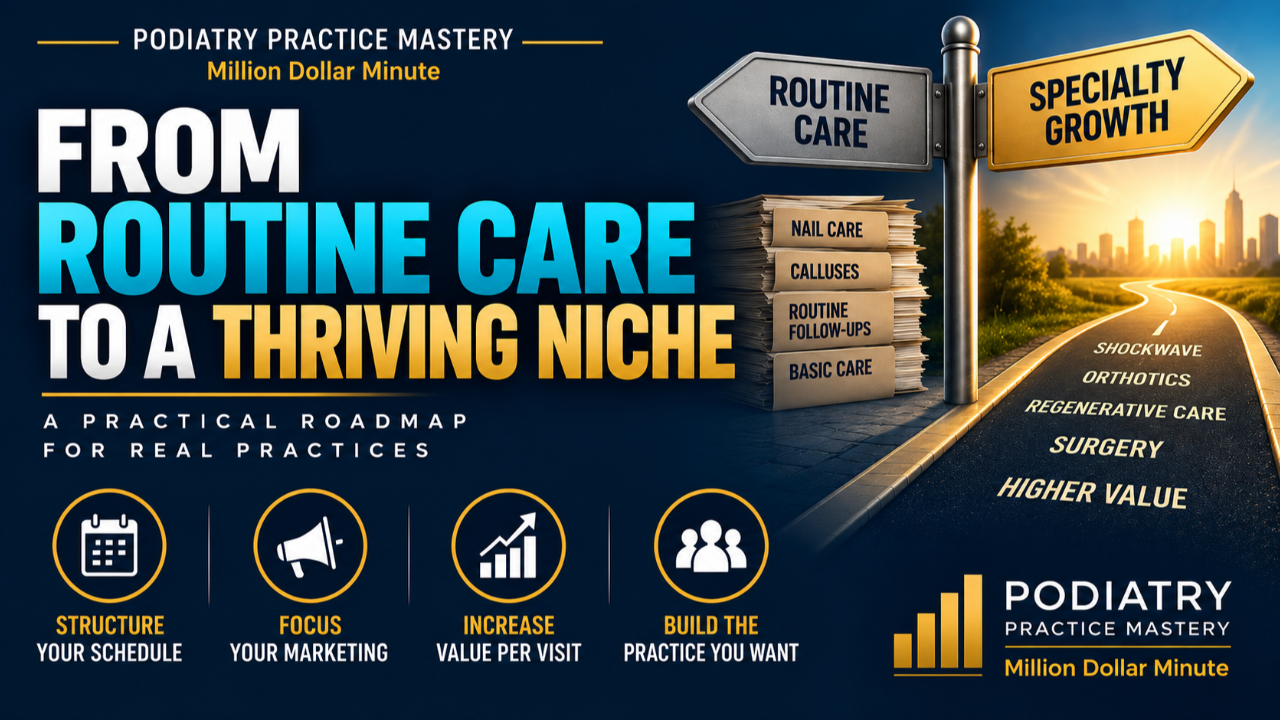
How to Niche Down a Routine-Care Podiatry Practice
Estimated reading time: 4 minutes
Here’s a great question I was asked:
“Everyone says niche down and stop being a generalist. But when 80% of my patients need basic foot care, how does that transition actually work? What does week one look like? What does month six look like?”
This is real life.
If you bought an established practice—or you’re in a heavy Medicare demographic—you may be routine-care dominant.
You have two paths:
- Make routine care more profitable
- Reduce routine care and build your niche
Let’s break both down.
Option 1: Make Routine Care More Profitable
If you’re going to keep it, optimize it.
Most doctors only look at the nail.
You have to look beyond the nail.
There may be additional medically appropriate opportunities within routine-care visits, including:
- Compression therapy for edema and lymphedema
- ABIs for appropriate patients
- Annual diabetic foot exams with a separate diagnosis
- Orthotics for callus offloading
- Matrixectomies for chronic ingrown nails
- Onyfix
- KeryFlex
- Fat pad injections such as Liposana
- DME, including braces and night splints when appropriate
Many routine-care practices can become more profitable by layering in medically appropriate services.
The key isn’t necessarily abandoning your base.
It’s elevating it.
Option 2: Reduce Routine Care and Niche Down
If you want to shift your practice toward plantar fasciitis, sports medicine, surgery or regenerative care, you need structure.
You don’t have to change everything tomorrow.
You can make the transition deliberately over several months.
Week One: Block It
Start by creating a dedicated routine-care day—or even a half day.
For example:
“Routine care is only on Tuesdays.”
Not scattered.
Not flexible.
Structured.
Patients will adjust.
And if some don’t?
That’s okay.
You’re building your future schedule, not protecting your past one.
Months One–Three: Control the Message
Next, change what you promote.
Your marketing should reflect the practice you’re trying to build.
That could mean:
- Website content: heel pain, Achilles problems, shockwave and orthotics
- Blogs: conditions you want more of
- Office posters and waiting-room videos: services you want patients to know about
- Email marketing: niche conditions you want to attract
The principle is simple:
You don’t advertise what you don’t want more of.
If you continually market routine care, you shouldn’t be surprised when more routine-care patients call.
Months Three–Six: Reduce Low-Value Follow-Ups
Here’s a big one that most doctors ignore.
Stop over-following low-revenue cases.
Examples might include:
- Paronychia → no routine follow-up
- Matrixectomy → one follow-up instead of two
- Fractures → code properly and reduce unnecessary rechecks
- Post-op patients → stretch out intervals appropriately
Then look at the length of your appointments.
Use 10-minute slots for quick checks.
Reserve 20–40-minute blocks for higher-value cases.
You’re intentionally freeing up space in the schedule.
What Do You Do With the Extra Time?
This is where most doctors hesitate.
They block routine care.
Now they have empty slots.
And they panic.
Don’t.
Use that time to:
- Market to referral sources
- Improve systems
- Add imaging such as ultrasound
- Build packages around shockwave, laser and orthotics
- Spend more time on profitable visits
For example, instead of spending 20 minutes with a plantar fasciitis patient, perhaps you now have 40 minutes available.
Wow them.
Do the imaging.
Dispense appropriate DME.
Explain the treatment.
Package the treatment.
You don’t need to immediately fill every minute you create with another patient.
You grow into the space you create.
The Real Shift
Niche down does not mean:
❌ Stop seeing routine care overnight
❌ Fire your patient base
❌ Become a completely different doctor tomorrow
It means:
✅ Structure your schedule
✅ Control your messaging
✅ Reduce low-value clutter
✅ Increase value per visit
✅ Gradually rebalance your patient mix
Over six months, your case mix can begin changing naturally.
That is a much more realistic way to niche down than trying to transform your entire practice overnight.
You Don't Niche Down by Announcement
You niche down through:
- Time blocking
- Marketing focus
- Clinical protocols
- Follow-up discipline
Ultimately, the goal is to:
Design your schedule around what you want your practice to become.
That is the real transition.
Key Takeaways
- You can either optimize routine care or reduce it. Both approaches can work.
- Block routine care into a dedicated day or half day to create structure.
- Promote the conditions and services you actually want more of.
- Eliminate unnecessary low-value follow-ups.
- Use newly created space to develop higher-value services and improve the patient experience.
If your schedule today doesn’t look like the practice you want five years from now, you don't necessarily need to make a dramatic change tomorrow.