
The Most Overlooked Revenue Lever in Podiatry (And It’s Ethical)
Estimated read time: 3 minutes
Durable medical equipment (DME) is an underused part of many podiatry practices. Boots, night splints, ankle braces, and AFOs all deserve a consistent place in the workflow when clinically appropriate.
The issue isn't whether they work.
The issue is whether you have a system.
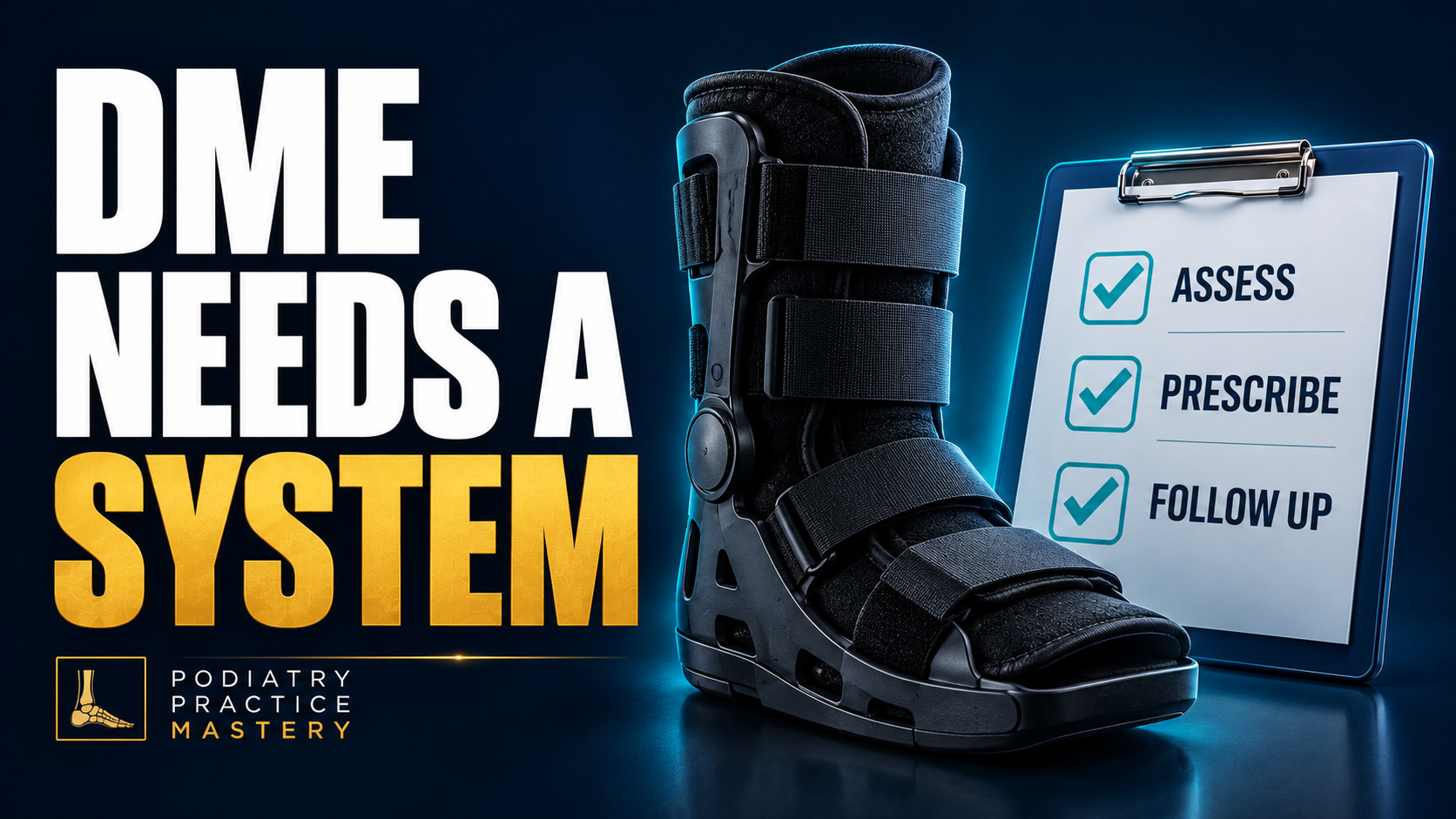
Many podiatrists already prescribe durable medical equipment (DME), but they don't necessarily have a consistent process for identifying appropriate patients, explaining the equipment, and incorporating it into treatment plans.
That's where I think there's a significant opportunity.
Protocol Beats Randomness
In our practice, we follow some fairly straightforward protocols.
For example:
- Most fractures get a CAM boot.
- Most equinus cases get a night splint.
- Many plantar fasciitis patients have bilateral equinus, so they get two night splints.
Not because we're trying to sell more equipment.
Because it's appropriate and prescribed clearly.
One thing I've learned is that patients respond better when you give them specific instructions rather than simply suggesting something they might want to try.
For example, when discussing night splints, I might explain:
"You'll wear this three hours per evening, alternating sides—or use two for convenience."
When patients understand exactly how they're supposed to use the equipment, compliance improves.
The important thing is having a consistent treatment protocol that you can explain confidently.
Don't Overlook Custom DME
Another opportunity is custom durable medical equipment.
Think about patients with chronic conditions such as:
- Posterior tibial tendon dysfunction
- Midfoot arthritis
- Advanced instability
For these patients, appropriate bracing can make a tremendous difference.
But many doctors don't pursue custom DME.
Why?
In my experience, there are three common reasons.
1. Licensing seems complicated.
Some doctors are hesitant because they aren't sure what requirements are involved in dispensing custom equipment.
2. They don't have a clear workflow.
Even when they recognize the need for bracing, they may not have a consistent process for prescribing, ordering, fitting, and dispensing it.
3. They're unsure when to prescribe it.
Without clear clinical protocols, DME can become something doctors occasionally recommend rather than a consistent part of appropriate treatment.
That's a lost opportunity.
Both clinically and financially.
The Real Secret: Prescribe Specifically
Here's what I think makes the biggest difference.
It's not simply offering DME.
It's prescribing it specifically.
There's a big difference between saying:
"If you want, you can try this."
And saying:
"For the best outcome, this is part of your treatment plan."
The second statement gives the patient a clear recommendation.
You're explaining that the equipment serves a specific purpose in their treatment.
Patients follow structure.
When you believe a particular brace, boot, or night splint is clinically appropriate, explain why you're recommending it and how it fits into the overall treatment plan.
Build a Consistent DME Workflow
The opportunity isn't just about the doctor making a recommendation.
Your staff also needs to understand the process.
When DME becomes part of your treatment protocols, your team can support the workflow more consistently.
That means the equipment isn't something you remember to discuss occasionally.
It's part of how you approach the appropriate condition.
Protocol beats randomness.
And when you prescribe equipment clearly, patients are more likely to understand its role in their recovery.
Ethical Prescribing and Practice Revenue
I think this is an important distinction.
There's nothing wrong with increasing practice revenue by providing appropriate treatment.
The key is that the equipment must be clinically indicated and prescribed for the patient's benefit.
When you consistently identify appropriate DME opportunities, you can improve patient care while also increasing the value of the services your practice provides.
That's a much better approach than simply trying to see more patients every day.
Key Takeaways
Here are the four main points I want you to remember:
-
DME should be protocol-driven, not optional. When equipment is clinically indicated, make it a clear part of the treatment plan rather than a vague suggestion.
-
Prescribe clearly and specifically. Explain why the patient needs the equipment and how to use it.
-
Train your staff to support the workflow. A consistent process makes it easier to incorporate DME into daily practice.
-
Ethical prescribing improves outcomes and revenue. Appropriate equipment can benefit patients while creating additional value for your practice.
The next time you're treating a patient who could benefit from a boot, night splint, ankle brace, or custom AFO, ask yourself:
Do I have a clear protocol for this condition?
And am I explaining the recommendation confidently?
Sometimes practice growth isn't about adding another treatment or finding more patients.
It's about becoming more consistent with the treatments you already provide.