
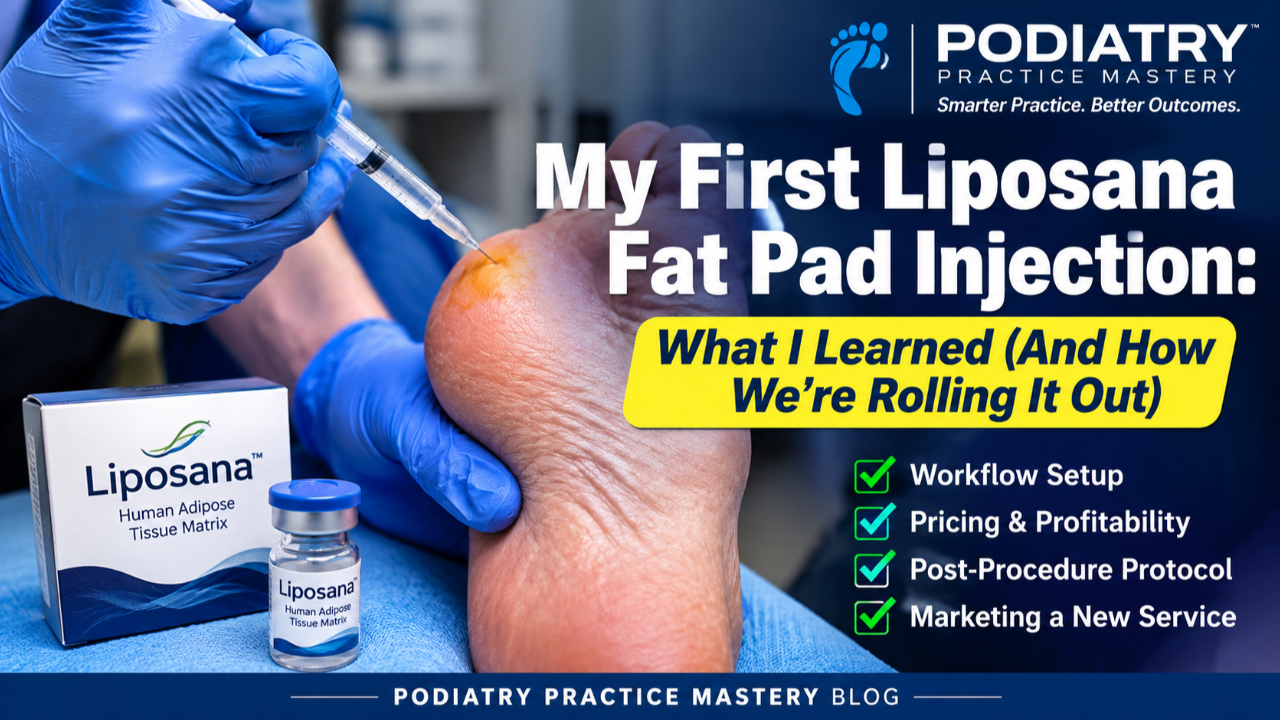
Liposana for Fat Pad Atrophy: My First Case
My First Liposana Fat Pad Injection: What I Learned (And How We're Rolling It Out)
Original Publication Date: August 24, 2026
Estimated Read Time: 5 minutes
I recently added something new to our practice: Liposana for fat pad atrophy.
This isn't something I've been doing for years.
I previously looked into Leneva and even received a sample at one point, but I never fully implemented it. After hearing more about Liposana at a recent conference, I decided it was time to move forward.
I recently treated my first patient.
Here's what I learned—not only about the procedure itself, but about how we're building the entire service around it.
Why I Started Offering Liposana
We all have these patients.
They come in with:
-
Painful plantar calluses
-
Significant fat pad atrophy
-
Limited improvement with orthotics
-
Gel metatarsal pads that help, but only a little
You debride the callus.
They feel better.
Then two weeks later they're back.
The problem is that we've temporarily reduced the painful callus, but the underlying lack of cushioning hasn't changed.
I wanted another option.
Liposana functions as a fat pad replacement. For the appropriate patient with significant fat pad atrophy, it gives us another option for creating cushioning in an area where very little natural padding remains.
Building the Workflow Before Doing the Procedure
One of my biggest takeaways from introducing any new service is that learning the clinical procedure isn't enough.
You need a system around it.
Before our first Liposana patient, we developed the operational workflow.
Deposit and Pricing
We're requiring a $500 deposit upfront.
The product is expensive and is ordered for the individual patient, so I didn't want to order it without a financial commitment.
We're currently charging $1,500 for 1.5cc.
For most individual metatarsal heads, we're anticipating needing approximately one syringe.
Storage and Paperwork
The product is stored in a small freezer in the office.
We also prepared:
-
Consent paperwork
-
Tissue-bank paperwork similar to what we've used with amniotic injections
-
Written post-procedure instructions
The goal is to make the process repeatable rather than reinventing it every time we identify a candidate.
My First Liposana Case
My first patient was a 90-year-old woman with significant pain beneath her first metatarsal head.
She had very little remaining fat pad.
I performed a V-block proximal to the first metatarsal head.
The Liposana was thawed in my hands for approximately two to three minutes.
I drew it up using an 18-gauge needle. They recommend a 20-gauge needle, and after doing the procedure, I understand why.
I inserted centrally and tented the dermis.
I then injected while retrograding from distal to proximal and fanned medially and laterally to distribute the material evenly.
Immediately afterward, you could genuinely feel that there was more cushioning beneath the metatarsal head.
That was encouraging.
But this is also my first case.
The important question isn't simply how it felt immediately after the injection.
It's how the patient does over time.
Our Post-Procedure Protocol
After the injection, we placed:
-
A Steri-Strip over the puncture site
-
Offloading padding
-
Gauze
-
Kling
-
Coban
-
Surgical shoe
Our current post-procedure protocol includes:
First three days: Heel weight-bearing only.
First two weeks: Weight-bearing in a surgical shoe.
After two weeks: Gradual transition back into normal shoes.
We're also recommending that patients avoid barefoot walking during recovery.
As we treat additional patients, I'm sure we'll continue refining this protocol.
Questions From My First Case
Any time you perform something new, questions come up that you didn't necessarily anticipate.
For me, one was bleeding.
There was a small amount of bleeding from the injection site.
That made me wonder:
Should I be using lidocaine with epinephrine?
And:
Could bleeding around the injection site affect the graft?
For this case, I used my standard block mixture without epinephrine, and everything appeared stable.
But it's something I'll continue evaluating as we do more procedures.
I think that's an important part of introducing anything new into practice.
You don't do one case and suddenly become an expert.
You implement.
You observe.
You refine.
The Practice Lesson: Don't Just Learn a Procedure
This experience reminded me that introducing a new treatment involves much more than becoming technically capable of performing it.
Before adding a new procedure, you need to answer questions like:
-
Who is the ideal patient?
-
How much does the product cost?
-
What should we charge?
-
Should we collect a deposit?
-
What paperwork is required?
-
How will we store the product?
-
What does the post-treatment protocol look like?
-
What does the staff need to know?
-
How will patients learn that the treatment exists?
That's how you turn an interesting procedure into an actual service within your practice.
Don't Forget to Market the New Service
This may be one of the biggest lessons.
Whenever I introduce something new, I'm trying to get better about creating content around it immediately.
For Liposana, I recorded the procedure using CapCut.
I flipped the camera between the patient area and my explanation of what I was doing.
Then:
-
The video went into Google Drive.
-
My virtual assistant added subtitles.
-
We prepared it for YouTube and the website.
-
We emailed our patient list about the treatment.
Think about how often doctors invest time and money learning a new treatment—and then barely tell anyone that they offer it.
If you're introducing a new service and not marketing it immediately, you're leaving momentum on the table.
You don't necessarily need an elaborate marketing campaign.
Start by documenting what you're already doing.
Learn it → systematize it → document it → market it.
Is Liposana Right for Every Patient?
No.
But for the right patient with true fat pad atrophy who hasn't received enough relief from conservative care, I'm excited to have another option available.
Now we need outcomes.
I'll continue evaluating the procedure, refining our workflow, and sharing what we learn as we treat more patients.
That's one of the things I enjoy most about practice.
We're always learning.
We're always testing.
And when something works, we build a system around it.
Dr. Donald Pelto
Podiatry Practice Mastery