
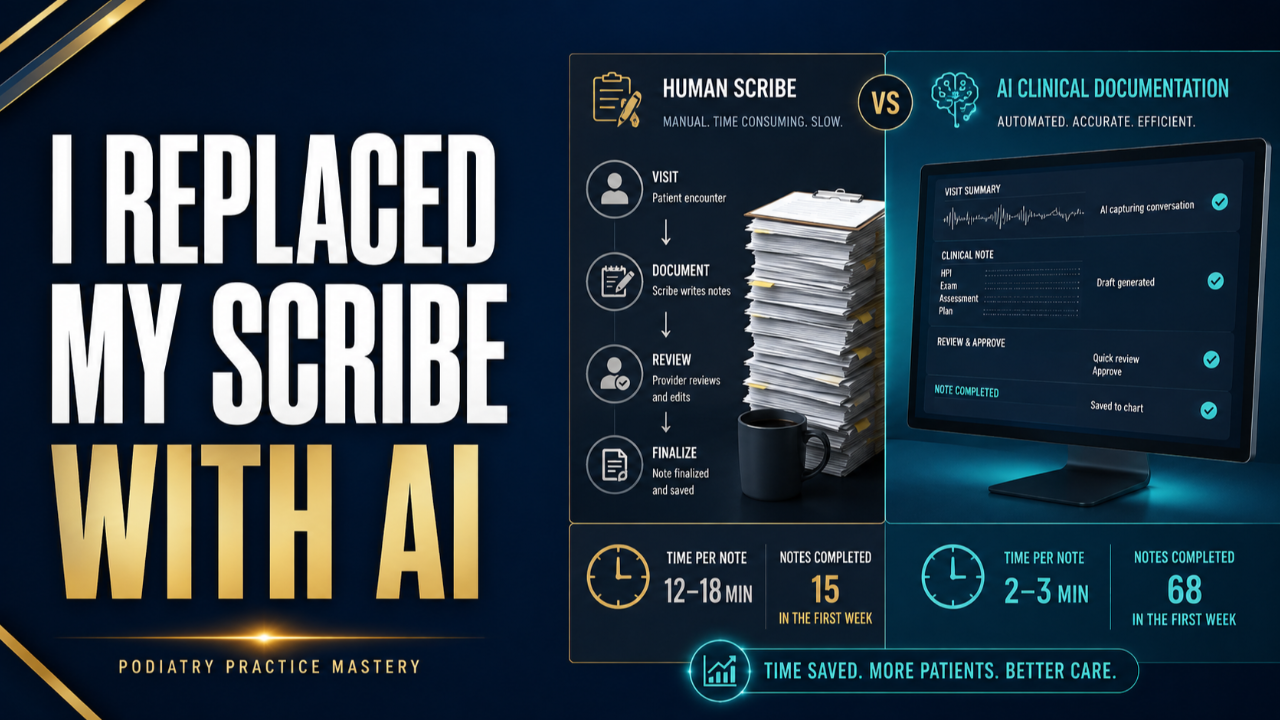
I Replaced My Scribe with AI: Week 1 Results
READ TIME – 4 MINUTES
I've been talking about AI for a while, but this week I finally jumped in and started using an AI scribe in my practice.
After spending years working with a real scribe, I thought the transition would be simple. It wasn't.
What surprised me most wasn't what the AI could do—it was what I had stopped doing.
Because my scribe handled so much of the documentation workflow, I had gotten comfortable letting someone else manage the details. Things like templates, diagnosis coding, fracture management documentation, and even where certain functions lived inside the EMR had become second nature for my scribe instead of me.
The first few days were rough.
Some notes worked great. Others needed significant cleanup. Ulcers, wound care, prescriptions, shockwave treatments, and more complex visits were definitely harder for the AI to handle accurately. Simpler encounters like nail care, nail biopsies, and diabetic foot exams were much smoother.
I quickly realized that AI isn't a replacement for good systems.
The better my templates and protocols are, the better the AI performs.
That's led me to start building structured protocols for common conditions:
- Plantar fasciitis
- Achilles tendinitis
- Ingrown toenails
- Wound care
- Compression dressings
Instead of expecting AI to do everything, I'm starting to see the future as a hybrid approach. AI handles the routine documentation, while protocols handle the situations that require very specific wording and compliance requirements.
One challenge I didn't expect was the mental load.
When I had a live scribe, I had more freedom to focus on side projects, presentations, and practice growth initiatives throughout the day. With AI, I still have to think through parts of the process and verify the output. It's not difficult, but it requires more attention than having a trained human sitting beside you.
That said, every day gets easier.
By the end of the week, I completed an entire day using the AI scribe without my regular scribe present. The more I learned where things lived in the EMR and how to communicate clearly to the AI, the faster the process became.
Another unexpected benefit is that it's forcing me to become a better user of my own software.
Many of the frustrations I encountered weren't AI problems—they were gaps in my understanding of workflows that my scribe had quietly managed for years.
I've also started using a tool called Whisper Flow for dictation on my desktop. If you spend a lot of time writing emails, working in ChatGPT, or documenting notes, it's worth looking into. It has made dictation significantly faster and easier.
So where do I stand after the first week?
The AI isn't perfect.
It's probably performing at 80-90% of what my experienced scribe can do today.
But it's improving quickly.
More importantly, it's forcing me to build better systems, better templates, and a better understanding of my EMR. I suspect that three months from now I'll be significantly more efficient than I am today.
Right now, I'm still learning.
Some days feel great.
Some days feel frustrating.
But that's usually what happens when you're building a new skill.
Key Takeaways
- AI scribes work best when supported by strong templates and protocols.
- Complex visits often require more customization than routine encounters.
- Many workflow frustrations are system issues, not AI issues.
- Learning your EMR more deeply can create long-term efficiency gains.
- A hybrid approach of AI + protocols may be the most effective solution.