
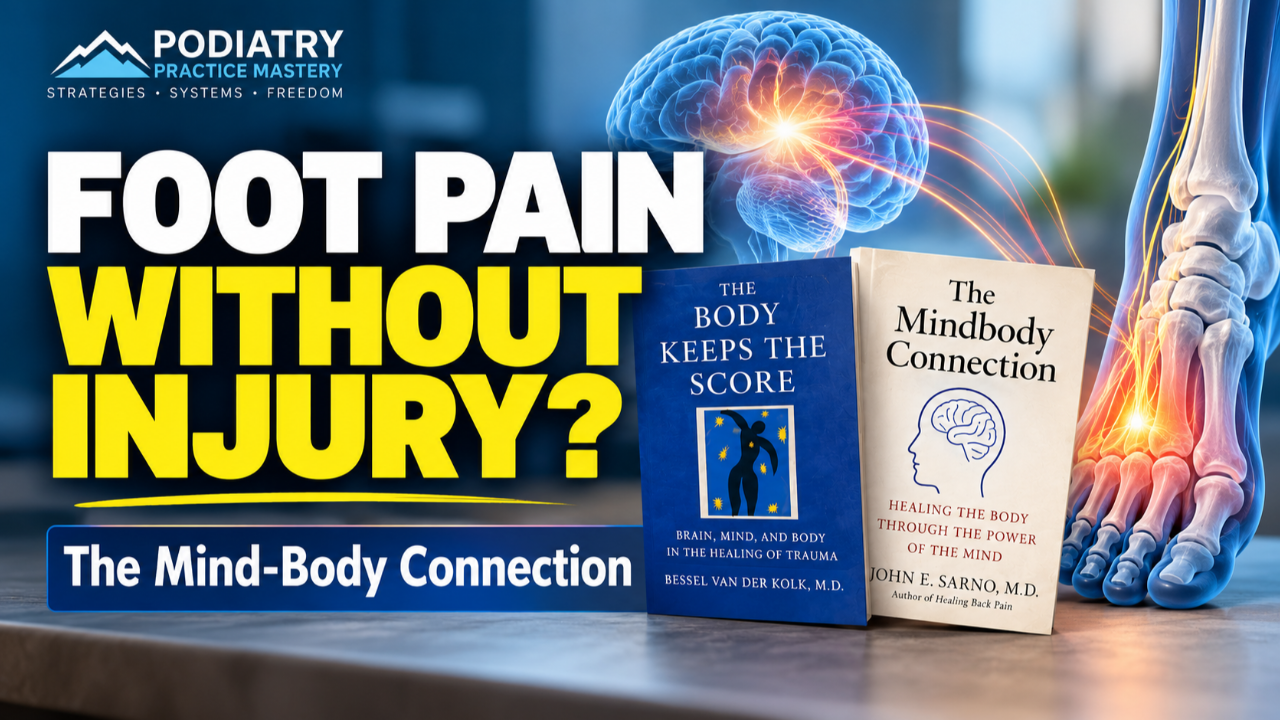
Foot Pain Without Injury: The Mind-Body Connection
Have you ever had a patient come into your office with significant foot pain, but you couldn't find an obvious injury?
I recently saw a young woman, about 25 years old, who had already been to three or four doctors. She had tried different shoes and orthotics, but she was still experiencing significant pain.
She was also getting ready to get married and had purchased white Hokas so she could walk comfortably at her wedding.
I really felt for her.
Here's what made the case interesting.
When I palpated her foot, she didn't have pain. But when she walked, she experienced pain around the forefoot and neuroma area. There was no Mulder's sign or other obvious finding that explained her symptoms.
When I see patients who have already visited several doctors, I sometimes ask myself:
Can I look at this problem a little differently?
I've read books such as The Body Keeps the Score and Dr. Sarno's work on the mind-body connection. They got me thinking about how pain and tissue injury aren't always the same thing.
Pain is real, even when we can't identify a clear structural cause.
With this patient, I asked permission to bring up a sensitive question about her past. She acknowledged a history of childhood abuse.
That didn't establish the cause of her foot pain, but it opened the door to considering additional factors.
I discussed the possibility that her nervous system and past experiences might be relevant, recommended some reading, and contacted her primary care physician.
The lesson here isn't that unexplained foot pain is psychological. It's that we shouldn't automatically assume every patient needs another orthotic, injection, or procedure.
We still need to evaluate possible physical causes carefully. But when the findings and symptoms don't line up, it may be appropriate to take a broader view.
Key Takeaways
-
Pain doesn't always equal tissue injury. A normal or inconclusive examination doesn't mean a patient's pain isn't real.
-
Ask permission before discussing sensitive topics. Patients should feel comfortable choosing what they share.
-
Think beyond the next procedure. Consider the broader clinical picture and collaborate with other healthcare professionals when appropriate.
Have you seen patients with similar presentations? I'd love to hear how you approached them.
P.S. Have you encountered a patient with significant foot pain but no clear structural explanation? Send me an email at [email protected]. I'd love to hear about your experience and may share the general lessons in a future podcast episode.