
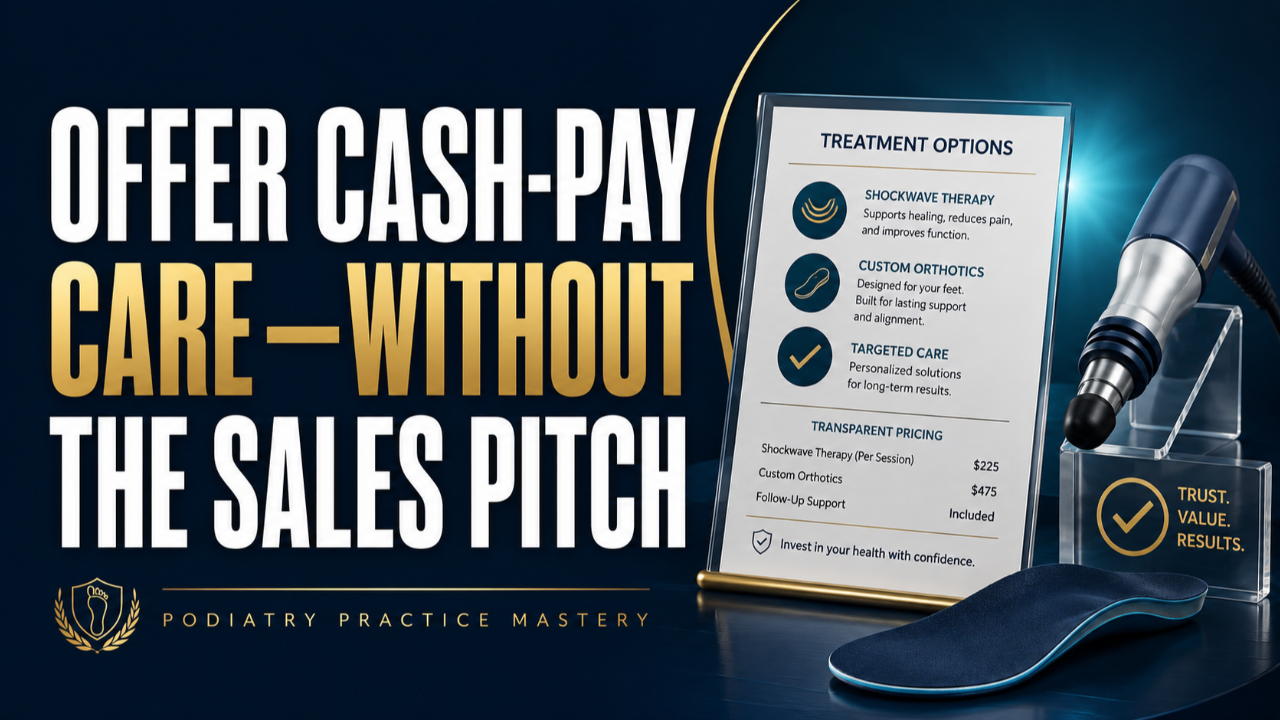
How to Confidently Offer Cash-Pay Treatments Without Sounding Salesy
READ TIME – 2 MINUTES
Hey everyone, Don here—welcome to Podiatry Practice Mastery, where we help you get your practice to the $1 million, $2 million mark—and beyond.
Today I want to do a deep dive into a really good question I got from Muhammad, sent my way through my friend Jim McDonald.
Muhammad asked:
“When you’re introducing cash-pay treatments like shockwave or biologics, how do you communicate value without patients feeling sold? And should the doctor or staff lead that conversation?”
Great questions—and ones we’re definitely not trained on in residency.
Step 1: You Have to Believe in What You’re Offering
This is non-negotiable.
If you don’t believe in the treatment, patients will feel it instantly.
My rule:
- If you wouldn’t do it for your mother
- Or wouldn’t pay for it yourself
👉 Don’t offer it.
That conviction is what makes conversations feel educational, not salesy.
When I first started shockwave, I did it free or very cheap until I truly believed in it. Same thing with biologics—I test things first so my confidence is real.
Belief comes from:
- Seeing results
- Training and conferences
- Trying it yourself
- Watching others use it successfully
Conviction can’t be faked.
Step 2: Timing Matters (Usually Visit #2)
High-ticket treatments are rarely a visit-one recommendation—unless you’re giving a second or third opinion.
That’s why I use treatment sheets.
Visit one = Phase One
- Ice
- Anti-inflammatories
- Stretching
- Shoe changes
Visit two = Phase Two
- Shockwave
- Biologics
- Orthotics
- Advanced care
Patients expect escalation after they’ve tried basics.
Step 3: Use Visuals to Build Understanding
Nothing builds value like seeing the problem.
I rely heavily on:
- Ultrasound (huge for shockwave acceptance)
- X-rays with simple written labels
- Side-by-side comparisons (right vs left)
When patients can see pathology, the price conversation becomes easier.
Step 4: How I Talk About Pricing
I usually introduce the option. My staff handles the logistics.
Example:
- Shockwave: $250 per session
- Typical course: 3–6 sessions
- 10% discount if they prepay
Why prepay?
- Saves staff time
- Simplifies scheduling
Patients like “one and done” decisions
Step 5: Should Staff Lead the Conversation?
They can—but only if:
- They believe in the treatment
- They’ve seen results
- They’re confident talking about it
Be careful: staff will project their own money beliefs onto patients.
Best case? 👉 The staff member actually performs the shockwave themselves.
That belief transfers.
A Smart Follow-Up Strategy
One idea I loved from another doctor:
If a patient declines a recommended cash-pay treatment, they sign a decline form.
Why this works:
- Reinforces the importance of the recommendation
- Creates a reason to follow up later
- Often leads to a “second yes” a few days later
I’m not fully using this yet—but it’s smart.
Key Takeaways
- Conviction beats scripts every time
- Cash-pay treatments work best as Phase Two options
- Treatment sheets guide—not sell—the decision
- Imaging (especially ultrasound) dramatically increases acceptance
- Staff can help—but only if they truly believe
- Clear, repeated phrasing builds confidence (“82% effective, speeds healing by ~50%”)