
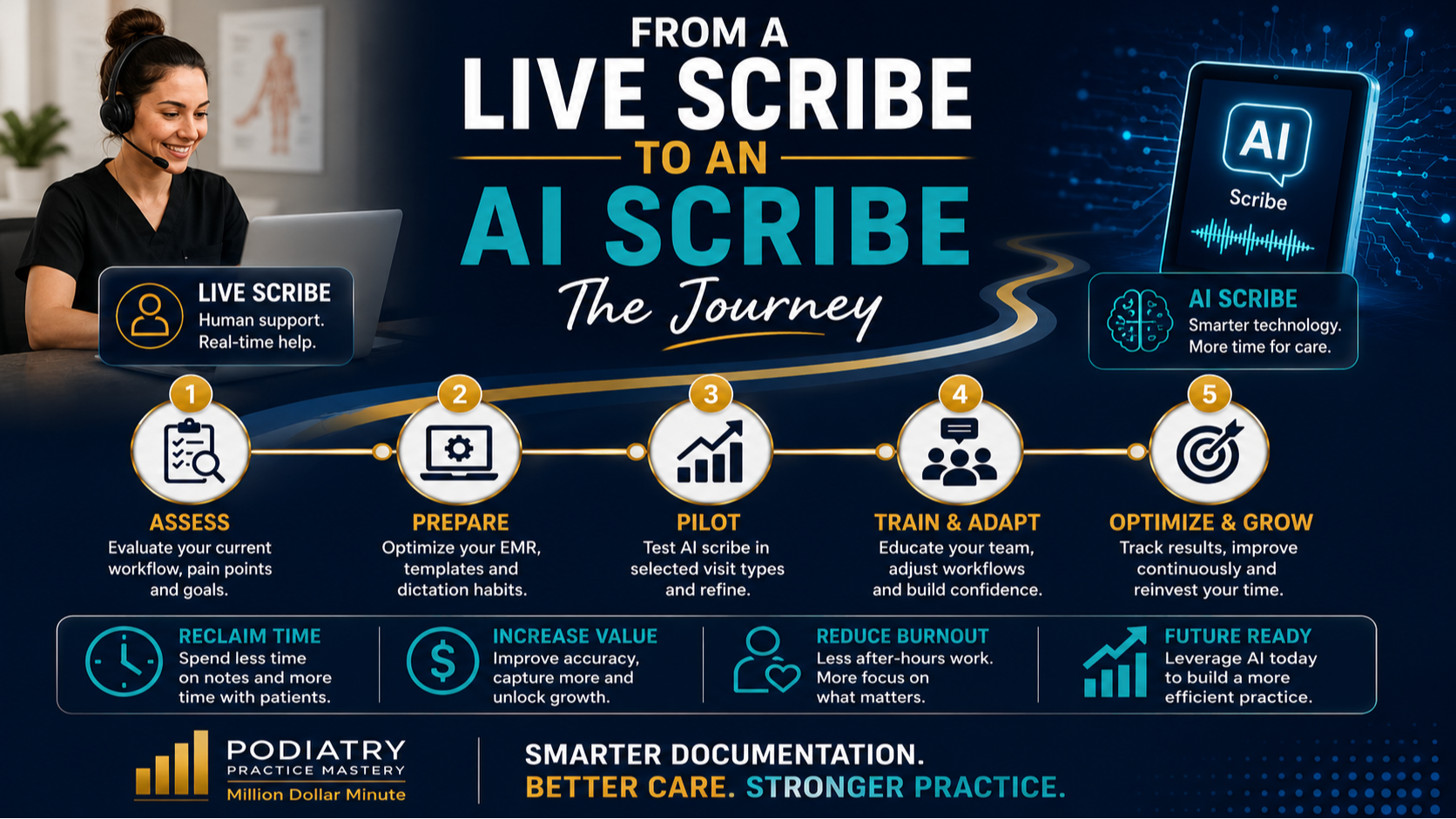
Decision resource for podiatrists
Spend More of Your Day Being the Doctor
I used a live scribe for years, struggled when I switched to AI, and eventually found a workflow I would choose again. Use these resources to compare your options and calculate what a scribe could be worth in your practice.
The goal is not better documentation.
The goal is getting the doctor back.
A good scribe does more than help write notes. A good scribe protects the physician’s time, attention and mental energy. It allows the doctor to focus on the patient instead of constantly moving between the patient and the computer.
I Loved My Human Scribe, But I Would Learn the AI Today
A trained live scribe learned my preferences and helped with documentation, orders, prescriptions, reminders, diabetic examinations, pathology and downstream workflow.
That improved patient presence.
But it also created dependence on one trained person. Sick days, vacations, training requirements and capacity limits all mattered.
In my experience, the live-scribe model was roughly $30,000–$40,000 annually. An AI scribe was roughly $4,000–$5,000 annually.
These are personal estimates only. Actual costs vary by practice, vendor, staffing model, visit volume and implementation.
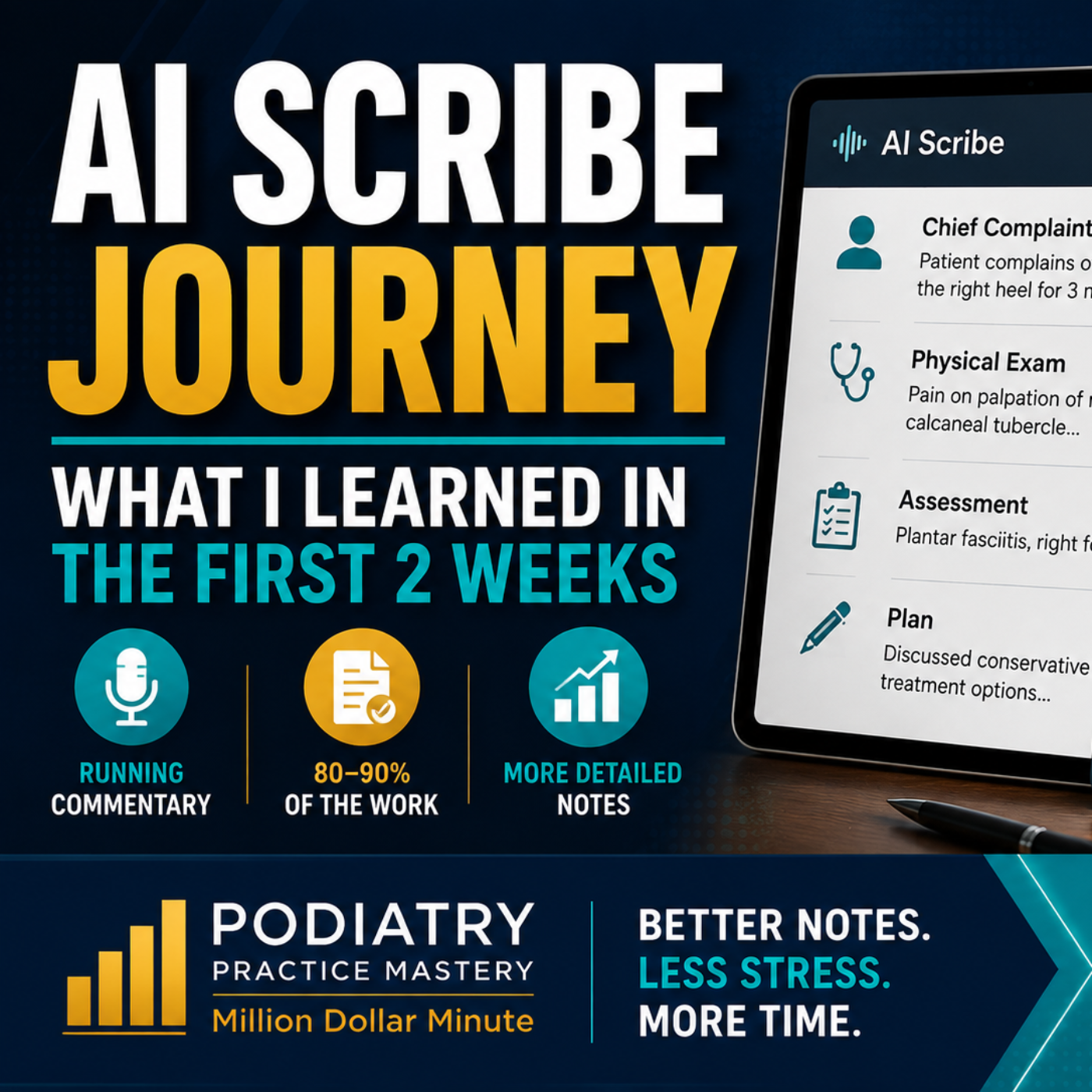
The AI transition was frustrating at first because it exposed gaps in my own EMR knowledge. After approximately two weeks, the workflow improved.
AI did not replace everything an excellent human scribe could do, but it handled approximately 80%–90% of what I needed.
What Could a Scribe Be Worth in Your Practice?
Create a calculator that can be completed in less than one minute. All assumptions should be editable.
Editable assumptions
- Patients per clinical day: 25
- Clinical days per week: 4
- Minutes saved per patient: 2
- Physician hourly value: $500
- Live-scribe monthly cost: $3,000
- AI-scribe monthly cost: $400
- Contribution per additional visit: $150
Formulas
- Hours recovered monthly = patients/day × days/week × 4.33 × minutes saved ÷ 60
- Monthly value recovered = hours recovered × physician hourly value
- Annual cost difference = (live monthly cost − AI monthly cost) × 12
- AI breakeven visits monthly = AI monthly cost ÷ contribution per additional visit
AI Scribe ROI Calculator
Estimate the time and financial impact of moving from a live scribe to an AI scribe in your practice.
Estimated Impact
Monthly clinical volume is estimated using 4.33 weeks per month. Hours recovered = patients/day × clinical days/week × 4.33 × minutes saved/patient ÷ 60.
AI breakeven visits = monthly AI-scribe cost ÷ contribution per additional visit. This estimates how many additional visits per month would be needed to cover the AI-scribe subscription.
The Trade-Off Is Human Judgment Versus Scalability
| Comparison point | Human scribe | AI scribe |
|---|---|---|
| Cost | Higher cost | Lower cost |
| Training | Significant training required | Workflow and protocol training required |
| Preference learning | Excellent with the right person | Improves through protocols, prompts and review |
| Unusual situations | Stronger when trained well | Requires physician verification |
| Downstream tasks | Can support reminders, orders and handoffs | Depends on integration and staff workflow |
| Availability | Person-dependent | Always available once implemented |
| Scalability | Volume-limited | Easier to scale |
| Risk | Sick days, vacations, turnover | Accuracy, integration and protocol limits |
A human scribe can understand what you usually do next. AI becomes most effective when your protocols and staff workflow provide that missing structure.
Live Scribe vs. AI Scribe: What I Learned After Using Both
By Donald E. Pelto, DPM • Approximately 8 minutes to read
For years, one of the best investments I made in my podiatry practice was hiring a live scribe. The reason was not simply that someone else wrote my notes. The real benefit was that I could look at my patients, listen to them and spend my day doing the work only a doctor can do.
A good scribe buys back more than time. A good scribe protects attention. I could move from room to room, stay present with patients and finish the day without carrying a pile of documentation home.
Eventually, however, I began comparing my live-scribe workflow with the AI scribe built into ModMed. I did not make the transition because I disliked my human scribe. In fact, the opposite was true: my scribe was excellent. That is what made the comparison meaningful.
My story is not, “AI is amazing and humans are obsolete.” My story is this: I loved having a human scribe, the switch to AI was painful, but after learning how to use it correctly, I came to believe AI was the better long-term solution for my practice.
|
THE CENTRAL IDEA The goal is not better documentation. The goal is getting the doctor back. |
What a Great Human Scribe Gave Me
After enough training, my scribe did far more than type what I said. He understood how I practiced. He helped with documentation, prescriptions, physical-therapy and MRI orders, pathology, reminders, messages to surgical staff, ABIs, diabetic foot examinations and the normal sequence of my day.
That is the greatest strength of an experienced human scribe: the person learns you. A trained scribe can recognize not only what happened in the room, but also what you usually do next.
The patient experience changed too. I would explain that my scribe was documenting the visit so I could focus completely on the patient. Instead of the encounter becoming doctor to computer to patient to computer, it became doctor to patient.
That level of presence is difficult to put on a spreadsheet, but patients feel it. The physician feels it too.
The Limitations of a Human-Dependent System
My human scribe was excellent, but the system still depended on one person. People get sick. They take vacations. They require training. They can leave. They also have a limit to how much volume they can manage at once.
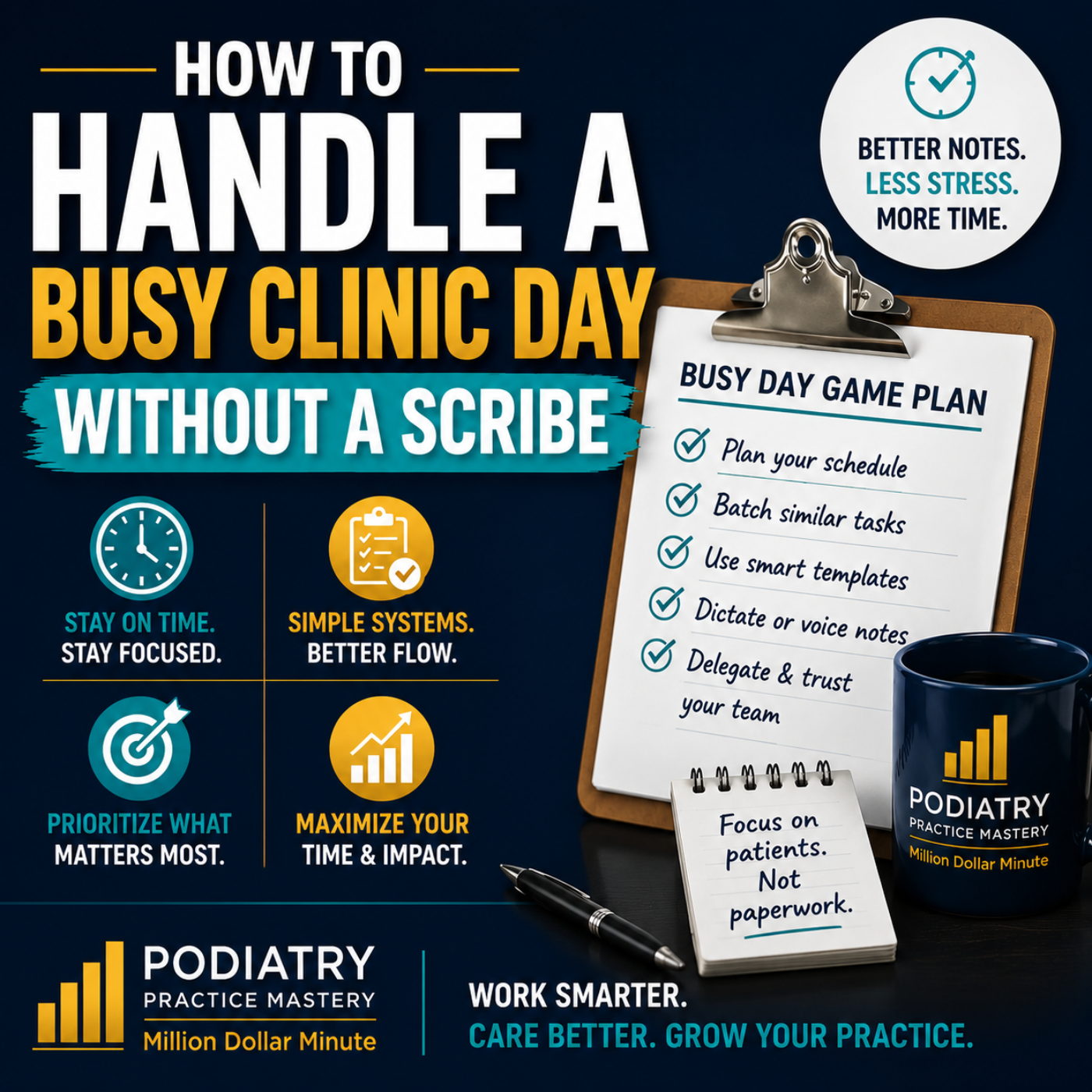
On some high-volume Fridays, particularly when I worked alongside my nail technician, I could see close to 50 patients instead of my more usual 20 to 23. Even a very capable scribe could become the bottleneck. When the volume rose, downstream items such as ABIs, diabetic examinations, follow-up tasks or pieces of documentation could be delayed or missed.
Then there was cost. My live-scribe model cost approximately $30,000 to $40,000 per year. The AI scribe was approximately $4,000 to $5,000 per year. Those numbers vary by practice and vendor, but the difference was too large to ignore.
Still, cost was not my only question. My real question was: Can AI actually do everything my scribe does?
My First Experience With AI Was Frustrating
Initially, the answer felt like no. I suddenly had to think about tasks that my scribe had handled almost automatically. I needed to review and reconcile information, learn where items lived inside the EMR, correct details, verify orders and become more intentional about what I said during each visit.
I struggled with things as basic as finding historical images, locating laboratory results, understanding the difference between the iPad and desktop workflows, and learning Visit Overview and reconciliation. There was more mental load, not less.
Over time, I recognized something important: not all of this was an AI problem. The transition exposed an EMR knowledge problem. My scribe had protected me from needing to understand portions of my own software.
That protection had been convenient. It had also made me dependent.
The Turning Point Came About Two Weeks In
After roughly two weeks, my opinion started to change. Each day I became faster. I realized the AI might not replace 100 percent of what an excellent human scribe could do, but it could handle perhaps 80 to 90 percent of what I needed for a fraction of the cost.
The easiest visits became especially efficient: routine nail care, diabetic foot examinations, biopsies, straightforward follow-ups and other predictable encounters. These visits have a consistent structure. Once the AI captures the conversation and the EMR has the right protocol, there is often very little left to do: record, review and sign.
The more complex visits remained harder. Ulcers, wound care, prescriptions, shockwave, DME, procedures and visits with multiple problems have more moving parts. The AI could create a beautiful narrative, but a beautiful narrative is not always a complete medical workflow.
|
THE DIFFERENCE AI is good at asking, “What happened in this conversation?” A trained human scribe can also ask, “What does Dr. Pelto normally do next?” |
That distinction matters. AI-generated documentation should still be treated as a draft. The physician remains responsible for verifying the clinical information, orders, procedures and billing.
The Biggest Lesson: AI Works Better When I Communicate Better
AI cannot read my mind. I learned to verbalize the details that mattered. Instead of silently thinking that I would order an MRI if the patient failed to improve, I would say, “If you are not improving, our next step will be an MRI.”
This improved the AI output, but it also produced an unexpected benefit: the patient heard the plan more clearly. Better communication for AI often became better communication with the patient.
AI Plus Protocols Is Better Than AI Alone
The real breakthrough came when I stopped thinking of the product as a recorder and started thinking of it as part of an AI-assisted clinical workflow.
For the conditions I treat repeatedly—plantar fasciitis, Achilles tendinitis, ingrown toenails, wound care, compression dressings and other common podiatric problems—I began building condition-specific protocols and templates inside ModMed.
The division of labor became simple:
AI captures what is unique about the encounter.
The protocol supplies the repeatable structure.
Staff complete the appropriate downstream tasks.
The physician verifies the clinical judgment and final record.
If I treat plantar fasciitis in a similar way many times each week, the AI should not be forced to reinvent the entire structure for every patient. I can create that structure once and let AI document what is different about the patient in front of me.
My 60-Second Review Philosophy
AI does not eliminate physician responsibility. My goal is not “AI writes it, and I blindly sign it.” My goal is “AI does the heavy lifting, and I verify what matters.”
My rapid review focuses on six areas: diagnosis, examination, plan, orders, procedures and billing. I do not need to rewrite every sentence. I do need to make sure the clinical record is correct.
In some encounters, the AI note is actually more detailed than the note I might have produced manually. It may capture counseling, treatment discussions and elements of medical decision-making that could otherwise disappear. More detail is useful only when it remains accurate and clinically relevant.
What I Would Tell a Podiatrist Starting Tomorrow
I would not tell a colleague to fire a scribe and simply turn on AI. I would tell the doctor to begin with five to ten predictable visit types and build the workflow deliberately.
Select your most repeatable encounters: routine nail care, diabetic foot examinations, plantar fasciitis, Achilles tendinitis, ingrown nails, warts, fracture follow-ups, orthotic visits, post-operative visits and wound care.
Decide what the AI should capture from the conversation.
Decide what the EMR protocol should supply every time.
Decide which downstream tasks belong to staff.
Create a short physician review checklist and measure actual time saved.
Published implementation research reaches a similar practical conclusion: ambient documentation can reduce burden, but success depends on technical stability, workflow integration, training, product fit and ongoing support. The technology matters, but implementation matters just as much.
The Economics Matter, but Time Is the Real Return
The annual cost difference between a live scribe and an AI scribe can be substantial. But I would not choose a scribe on cost alone. The greater return is physician time and attention.
If AI saves only two minutes per patient across 25 patients, that is 50 minutes in a day. Across four clinical days, it is more than three hours of physician time each week.
That time can become another patient, a procedure, a shockwave consultation, practice development, teaching, exercise, dinner with your family—or simply going home.
My Conclusion
Human scribes taught me what great documentation support could feel like. AI showed me how much of that support could be automated.
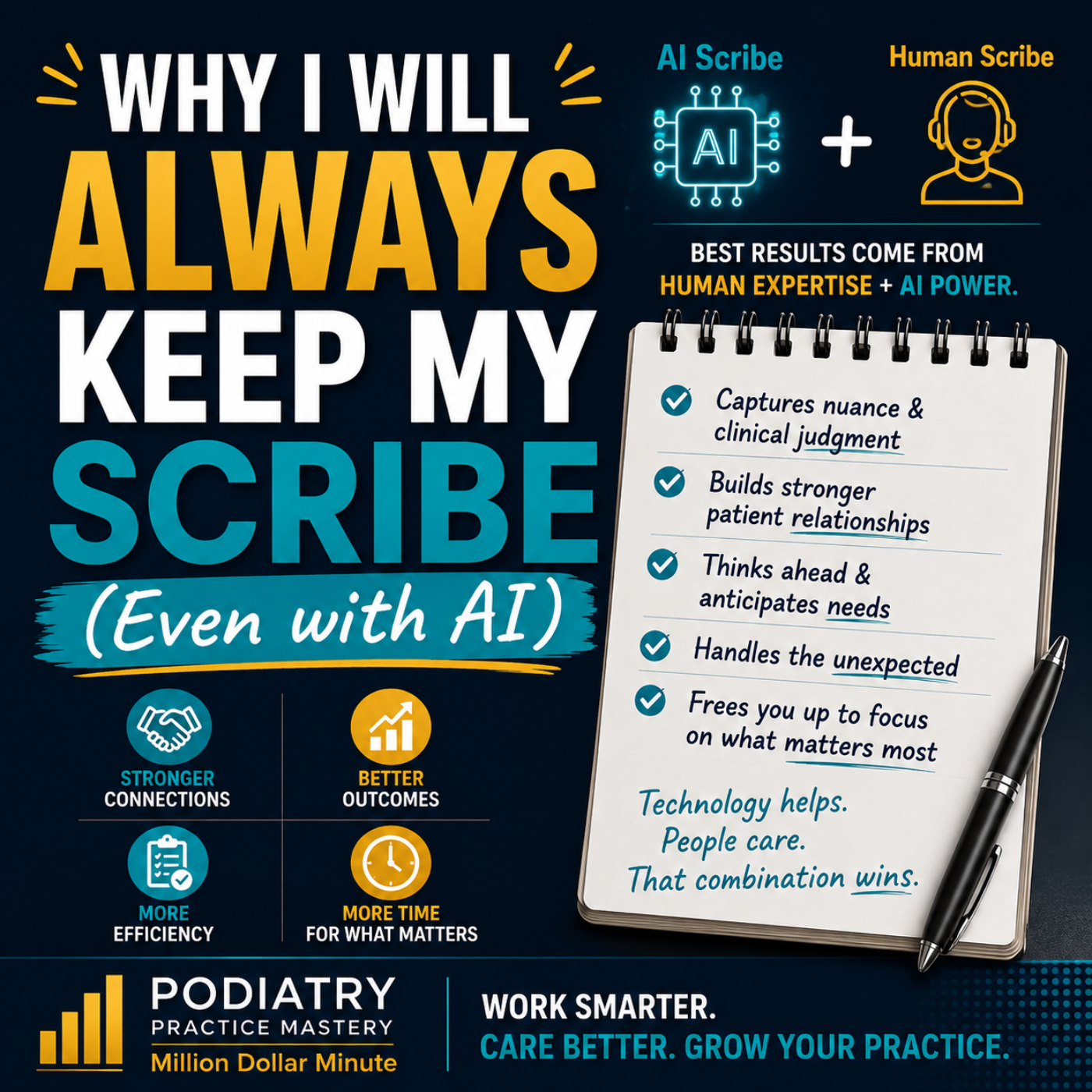
I do not believe AI currently replaces every capability of an excellent human scribe. But when I combine AI, ModMed, protocols, staff workflows and physician review, I have a system that is less expensive, more scalable, more consistent, always available and improving over time.
If another podiatrist asked whether I would hire a live scribe or learn to use an AI scribe if I were starting over today, my answer would be simple: I would learn the AI.
|
NEXT STEP Compare the options, calculate the potential return and see the scribe workflow resources I use. |
Disclosure: Some resource links may become referral links. If so, I may receive compensation at no additional cost to you. I recommend only tools and services I have personally used or carefully evaluated.
References
Implementation evaluation of ambient AI documentation in ambulatory practice: PubMed
ModMed Scribe 2.0 product overview: ModMed
Follow My Scribe Journey
Use These Resources to Make a Better Decision
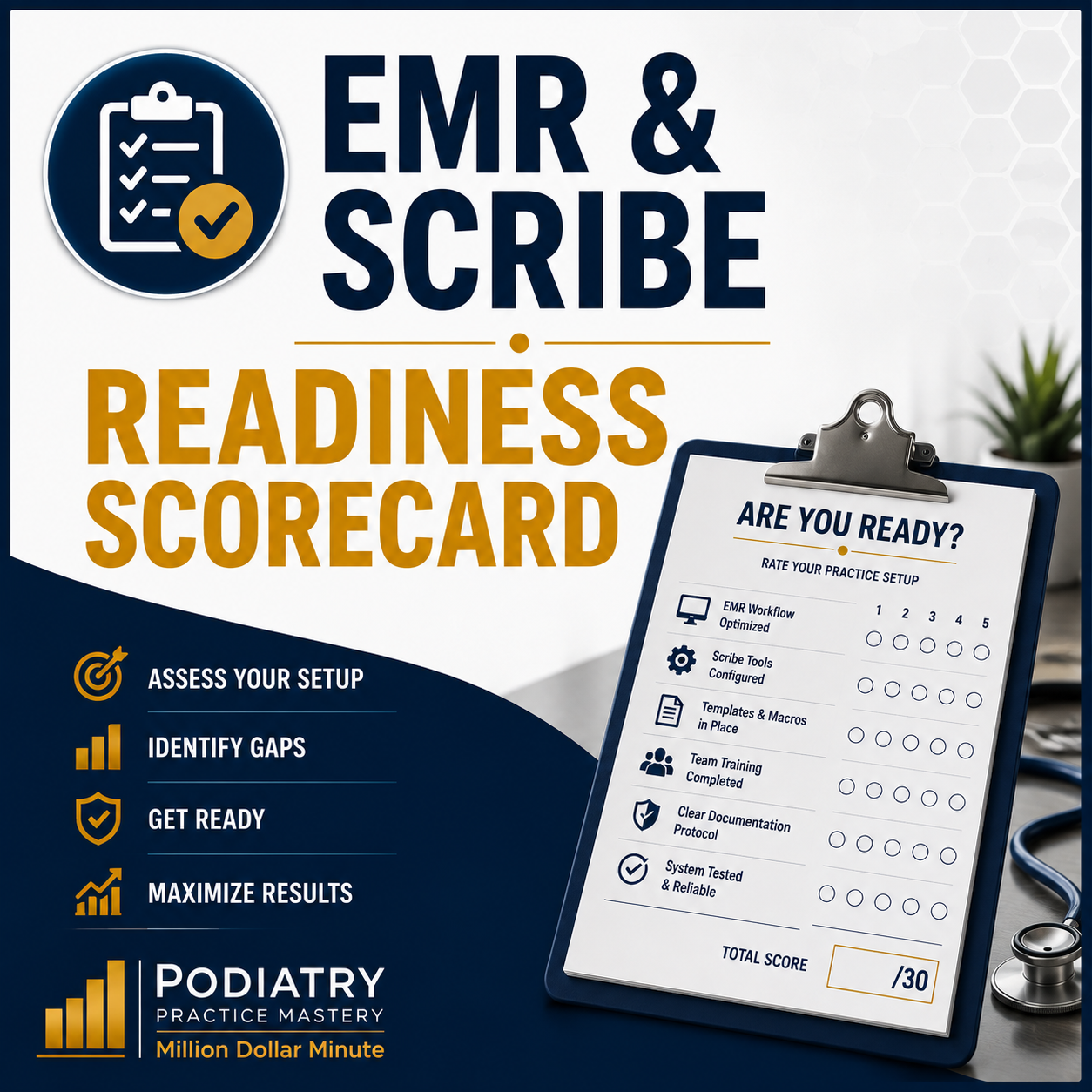
EMR & Scribe Readiness Scorecard
Evaluate AI integration, templates, protocols, orders, mobile/desktop workflow, training, support and data access.
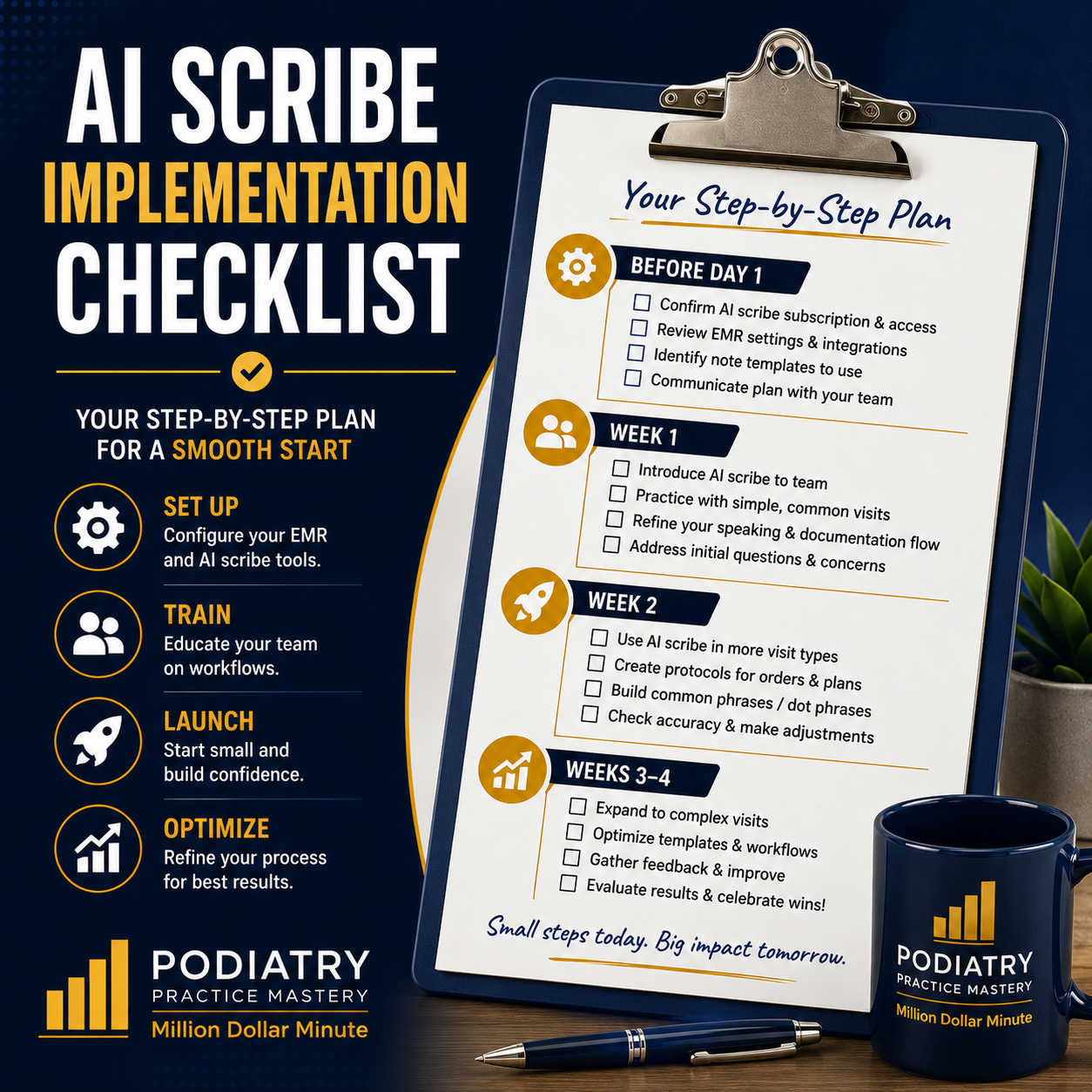
AI Scribe Implementation Checklist
Cover the first ten visit types, staff roles, protocols, patient explanation and physician review.
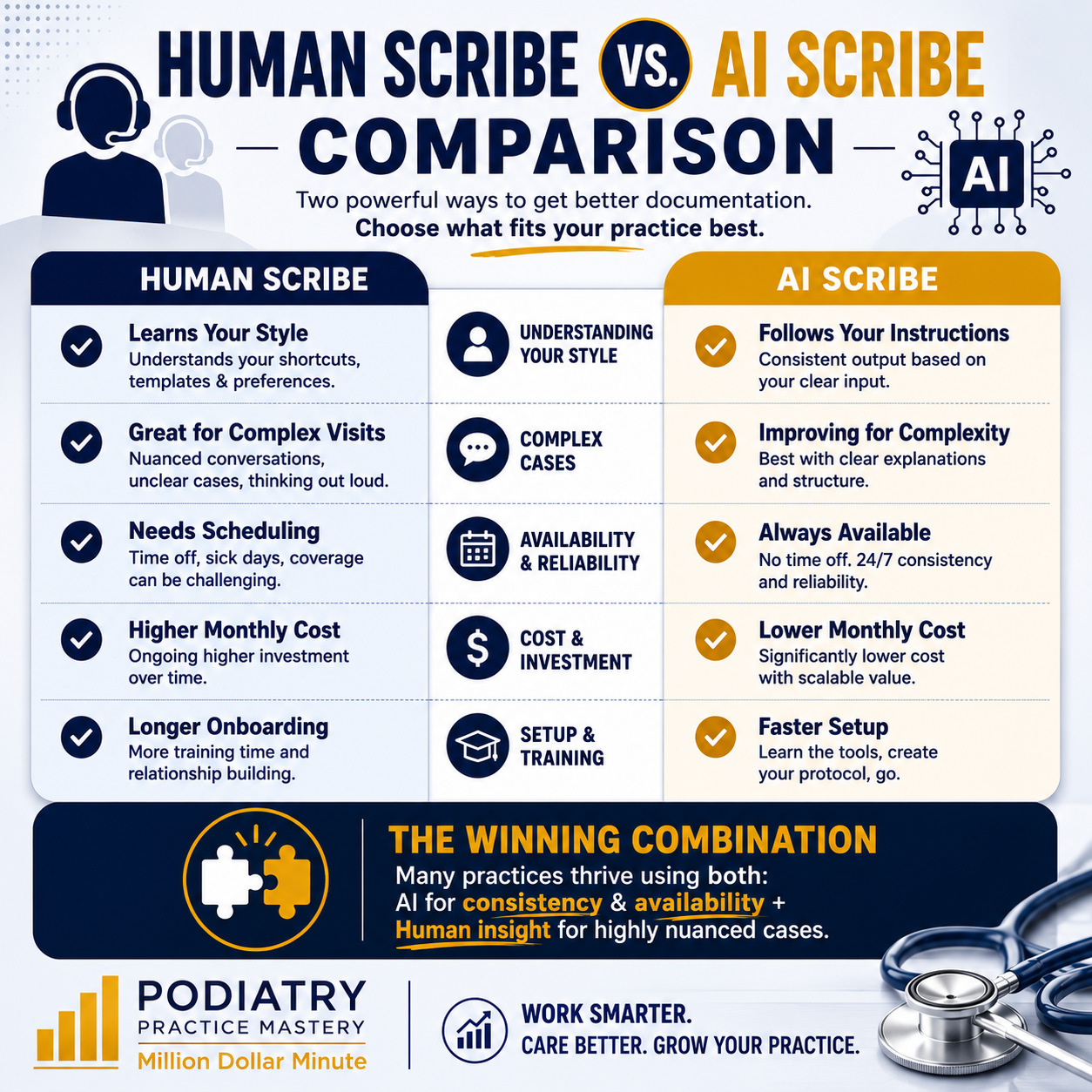
Human Scribe vs. AI Scribe Comparison
Printable summary for practice partners and administrators.
Do not require a scheduled call.
Questions Podiatrists Ask Before Choosing a Scribe
How accurate is an AI scribe?
Does the physician still need to review the note?
How long does it take to learn an AI scribe workflow?
What visit types work best with AI scribes?
What about complex visits?
Can AI handle orders and prescriptions?
When is a human scribe better?
How should patients be told about a scribe?
What happens during downtime?
What about privacy, HIPAA and vendor agreements?
Does AI need EMR integration?
Do I need to change EMRs?
Which Scribe Model Fits Your Practice?
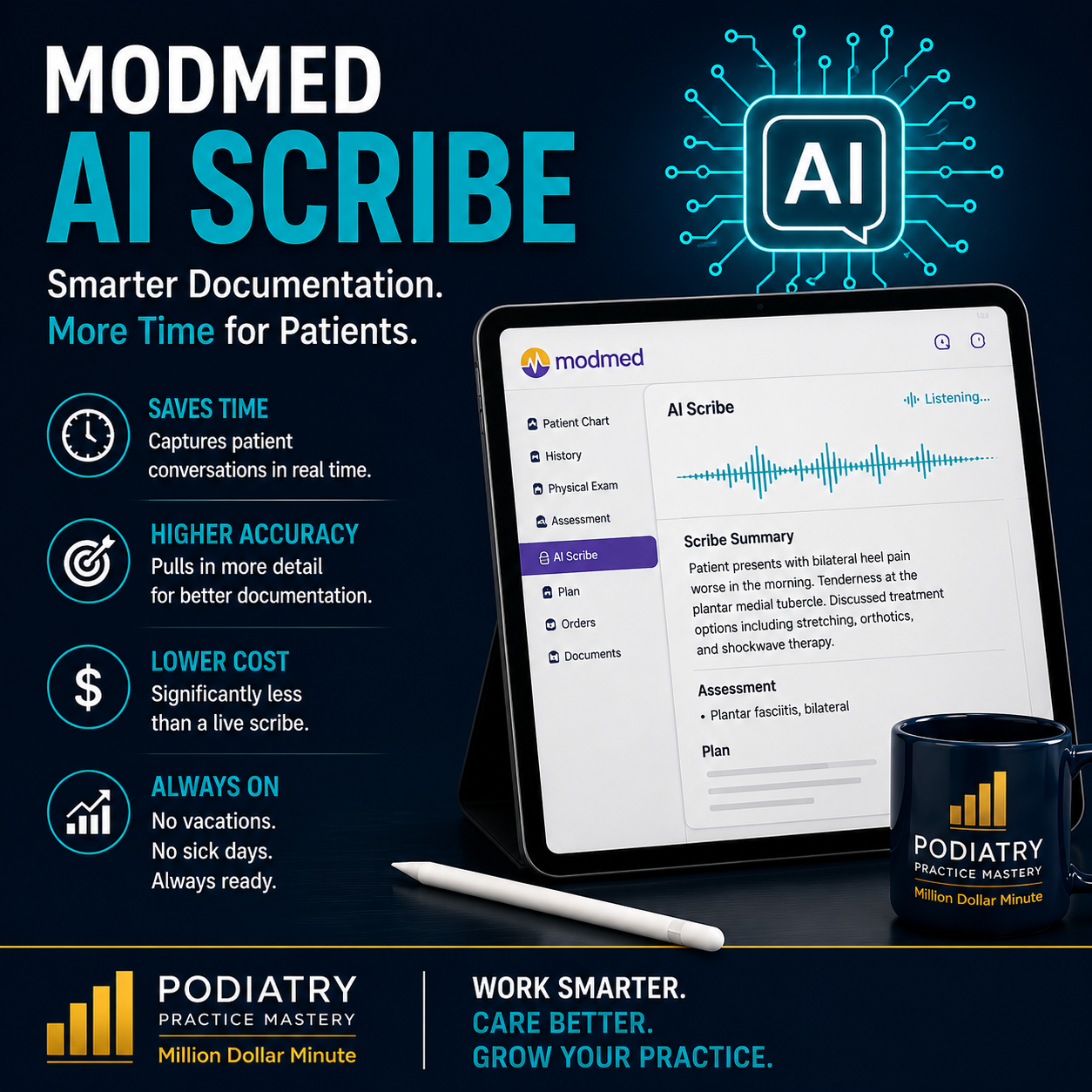
Explore ModMed AI Scribe
For podiatrists wanting an integrated, scalable AI-assisted documentation workflow.

Explore a Live Scribe
For podiatrists wanting human judgment, personalized workflow support and downstream task completion.
Share More Scribing Resources With Me
Put in your contact information, and you will get more scribe resources directly to your email.
Do not submit patient information through this form.
About Don
Donald E. Pelto, DPM, is a practicing podiatrist and foot-and-ankle surgeon at Central Massachusetts Podiatry. He hosts the Podiatry Practice Mastery Podcast and teaches podiatrists how to improve clinical workflows, increase practice efficiency and spend more time doing work only the doctor can do.
This resource is based on his firsthand experience using a trained live scribe and ModMed AI Scribe in a busy podiatry practice.
Get the Doctor Back
Compare your options, calculate the potential return and choose the next step that fits your practice.
Affiliate Disclosure
Some links on this page may be referral or affiliate links. If you choose a product or service through one of these links, Donald E. Pelto, DPM, or Podiatry Practice Mastery may receive compensation at no additional cost to you.
Recommendations are based on personal experience or careful evaluation. Compensation does not guarantee a favorable recommendation.